Wednesday, November 23, 2011

Blog Things: Amazon Links, New Poll, Page Numbers, and More

Here are just a few blog things that I wanted to mention.

This picture is from the B-T Convention website. I hope they
don't mind that I used it. I thought it was very clever! {Source}
The original, unaltered image appears in Betsy Was a Junior.

Betsy-Tacy Convention 2012 

Speaking of the Betsy-Tacy Convention,  I have added a banner to the sidebar to spread the word about this. You can visit the website for lots more information.

Amazon Associate Links

I set up an Amazon Associate account. I don't actually expect to make money on this, but I wanted some way to display a link to where new readers could buy the books. You will now notice the Betsy-Tacy and Deep Valley books listed in the right column. I contacted the Betsy-Tacy Society to say that I would be happy to post the links to their account, but I never heard back from them. I do encourage you to support them also, if you plan on buying something. Just so you know, clicking through these links does not add any additional charge to the items.

A New Poll

I set up the first poll on here. You will notice that on the top right. The question is: "Which man was right for Betsy?" In other words: who do you think she should have ended up with, or are you pleased with how things turned out? Several people have already voted and I am a bit surprised at the loyalty to Joe. I thought there were some diehard Tony fans out there. Or Marco? Don't get me wrong; I like Joe and I think he was right for Betsy…but what do you think?

I realized I accidentally left Dave Hunt off of the poll. I can't fix it now because there are already votes. Hopefully no one was planning on picking him! If you were, just click 'Other' and leave a comment on this post with your selection. Or if you had someone else in mind that I overlooked, you can do the same thing. Feel free to write and comment on this post why you chose who you did!

Giveaway Winner Announced

The giveaway has ended and I have contacted the winner. Thank you all for participating, and for your great suggestions!

A Note About Page Numbers

You may have mentioned that I try to source any quotations given from the B-T or Deep Valley books. I debated about which page numbers to use, and eventually decided on the latest editions of the books from Harper Perennial (because those are the ones that I own). The only draw-back to this  is that all of these volumes except Emily of Deep Valley have bound together two or more of the books. This makes it confusing when pointing out page numbers because the earlier single editions will have a different number (I hope that made sense). I really wish they had restarted pagination for each book, even if they are bound together. Alas, they did not. The point of mentioning this is if you go to look up or read more about a section I mentioned, it might not line up with the edition you have (unless you have the latest printing). I know this is confusing, so if you have a question be sure to let me know. (Note: I went back and corrected previous posts that used different editions. All quotes on this blog should now be from the most recent printing of the Betsy-Tacy and Deep Valley books. These are the editions linked in the right column.)

Does Anyone Know What This Is?

I came across this the other day in my random searching for Betsy-Tacy things. Are they zines or something? They look interesting! (If you click on one it shows the contents.) I am especially intrigued by the "Betsy-Tacy Christmas" and Emily of Deep Valley ones. 

I think that covers it for now. Remember to vote in the poll!  : )

Monday, November 21, 2011

Pompadours, Part 1: Women's Styles

One of the things I wondered about most when I first read the Betsy-Tacy series was what is this thing called a pompadour? It seemed to be a hairstyle of some sort, and Maud mentions them quite frequently--on both men and women. So how could they both have the same hairstyle? It's all very puzzling. Well, apparently I'm not the only one who has wondered about the mysterious pompadour. I've received a couple questions in the giveaway post (you have until tomorrow to enter!) from others who are wondering about this. In one such comment a B-T fan named Marissa wrote:
Pompadours. 1). Why are they mentioned so frequently in the Betsy/Tacy series? 2). Why is that word so hard to say? 3). What were they exactly? How can both men and women have pompadours? Why is Joe Willard's pompadour so fabulous? What makes a pompadour more special than regular hair? It is mentioned so much in the books, I am quite perplexed. I'd love a little ditty all about pompadours with perhaps a picture or two.
It's sounds like we've been wondering many of the same things! Never fear; in this post I plan on addressing all of those questions and more (although I don't think I can give a reason why "Joe Willard's pompadour is so fabulous." I think it just is.)

There is a difference between the men's and women's pompadours. This post will talk about the women's version. 

First things first: how do you say "pompadour." According to Merriam-Webster, it is pronounced:
pom·pa·dour (päm-pə-ˌdȯr)
If you'd rather hear what it sounds like, there  is a handy site you can go to just for this purpose. All you have to do is type in the word and click on "Say it!". 

So what exactly is a pompadour? 
Pompadour 
Any hairstyle with the hair brushed back and arranged up creating a puffy effect. Variations were especially popular in the 18th century and in the late nineteenth and early 20th centuries.{Source}
The pompadour could take many forms, from a simple topknot (left) to series of
more elaborate poufs and curls (right). {Source}
The pompadour hairstyle or the 'Gibson girl' look was seen pretty much throughout the Edwardian period, 1901-1912 and was worn by women from the working classes to society ladies. The style is quit [sic] 'pouffy' right around, with the ends of the hair either tucked into a roll at the back or formed into a bun on top .... {Source}
In this illustration by Charles Dana Gibson, the women pictured
are all wearing a variation of the pompadour hairstyle. {Source}

As to why this style is mentioned so frequently in the series, I can only think that it is because it was an especially popular way of doing one's hair during the period in which these books take place. Also, I imagine that in the early 1900s putting one's hair up, as with wearing longer skirts, was a sort of a coming-of-age thing. Now that Betsy and her friends are in high school, they are growing up. Paying attention to the fashion mentioned in this series shows the outward signs of their blossoming maturity. But perhaps Maud just really liked the word!

Now that you know what this style is, I'm sure you will recognize it a lot in Vera Neville's lively illustrations. (Lois Lenski also draws a few pompadours on Mrs. Ray, Mrs. Muller, Mrs. Kelly, etc.)

To achieve the illusion of added volume, women would use "rats" (made from matted hair cleaned out of the hairbrush or horsehair), frames, back-combing, or other forms of padding. Also:
None of the hairstyles of the day would have been accomplished without firm hair pins made of much heavier wire gauge than those used in hairpins today. {Source}
There are many mentions in the series of the methods used to construct these hairdos: 
Betsy shows off her transformation hairstyle to Tib in  
Betsy in Spite of Herself. Illustration by Vera Neville.
[Tib] looked at Betsy keenly. "I know a wonderful way to do your hair."
    "How?"
    "Come here and I'll show you."
    They went to the dressing table, and Tib asked for Betsy's biggest rat. She pinned it on firmly and erected a magnificent pompadour, topped off with a high, pointed knot. (Betsy in Spite of Herself, 536)
She fluffed Betsy's hair over the wire "jimmy" into an airy pompadour. (Betsy Was a Junior, 142)
I'm not sure what a jimmy is or how it's different than a rat. I was unable to find any information online about it.
Tib had come as usual to dress for the party with Betsy – and to do Betsy’s multiplicity of puffs. The pompadour was rolled over a big sausagelike mat and each puff was rolled over a small one.
    “The rat and all the little mice, Tony calls them,” said Betsy, acting lighthearted. (Betsy and Joe, 479)
I hope this cleared things up on the subjects of women's pompadours. Let me know if you have any questions and I'll see what I can find out.

Link:
Style your own Gibson Girl updo. This site  also links to some video tutorials (which I haven't watched).

>> Pompadours, Part 2: Men's Styles

Saturday, November 19, 2011

Wildflowers in Betsy and Tacy Go Over the Big Hill

A couple weeks ago, I highlighted the wildflowers mentioned in Betsy-Tacy and Tib. Today I'm going to feature the ones from Betsy and Tacy Go Over the Big Hill. Like last time, I omitted the common flowers, like daisies and violets. (Click image for source.)
They walked back slowly, picking flowers as they went. They didn't find many violets, but they found bloodroots, and Dutchman's breeches, and hepaticas, rising from the damp brown mat which carpeted the ground. (288)
Bloodroots


Columbine
Dutchman's breeches
Indian paintbrush
They scattered the flowers picked that morning on the hill, columbines and daisies and the scarlet Indian paintbrush. (442)

Hepaticas
Jack-in-the-pulpit

The went down the hill, running sometimes and walking sometimes, picking columbines and yellow bells and Jacks-in-the-pulpit and daisies to make a bouquet for the princess. (427)
Yellow bells

Some of these, like the Indian paintbrush and yellow bells, had different pictures come up for them. Hopefully I got the variety that would be indigenous to Minnesota. If any of you are gardeners, botanists, or flower experts, feel free to correct me!

Wednesday, November 16, 2011

"Merry Widow" Fever

{Source}
One of the (many, many...) things I love about the Betsy-Tacy series is their incorporation of popular music. One piece, "The Merry Widow Waltz", is practically a character in Betsy in Spite of Herself.
The Merry Widow was the world’s first hit musical. The tremendous acclaim that accompa­nied its premiere in Vienna on December 30, 1905 brought instant fame to its thirty-five-year-old composer, Franz Lehár, and began an international success. In the century since, there has scarcely been a night without a performance somewhere in the world. {Source}
Author, blogger, and Betsy-Tacy fan Melissa Wiley did a post last year featuring this lovely waltz. Since she did such a great job, I won't try to say it all again. Just head over to her blog, Here in the Bonny Glen, to:
  • Hear what this waltz sounds like
  • Read the excerpt from Betsy in Spite of Herself when she first hears it while in Milwaukee
  • See a list of links relating to the song, including a funny gallery of postcards poking fun at the extravagant style of hats inspired by the piece
These photos are in the back of Betsy In Spite of Herself
Speaking of Merry Widow hats, these are also mentioned several times in Betsy In Spite of Herself. For example:
Beside him was a slight graceful girl, beautifully and expensively dressed in a gray suit with a big fluffy fur and a Merry Widow hat so wide that it made the one Betsy cherished in a box upstairs look positively narrow. (606)
"Tell Irma if she wants to see the Merry Widow, she can just come up and look at me."
    "You don't sound very heartbroken."
    "I'll put on my Merry Widow hat for her," Betsy joked. (645)
The first quote leads me to think that the bigger the hat, the more stylish you were! Do you remember in the post on shirt waists how I described the S-shape silhouette that was popular in the early 1900s? Well, as the new century wore on, a different shape came into vogue, hallmarked by the rise of the Merry Widow hat:
1907-8 saw the start of a new body silhouette called the Empire or Directoire where the long columnar outline that tapers to the feet is contrasted with the big Merry Widow picture hat.  The fashion designer Lucile had designed the original widow hat for an operetta in 1907, but it influenced hat fashions for 3 more years.  It was always black and encased in filmy chiffon or organdie and festooned in feathers. {Source}
Lily Elsie modeling the Merry Widow
hat designed by Lucile. {Source}
While Franz Lehar’s 1905 premier of The Merry Widow did give this beautiful and often outrageous hat its most well known name, the hat in general had already begun to grow larger and larger since the end of the 19th century. It now took on gargantuan proportions compared to its predecessors. As is often the case, fashion had its own logic; As [sic] the new century moved forward, a larger millinery style was required to accommodate the larger and very popular pompadour hairstyles. By the middle of the new decade waistlines were radically raised and skirts became much slimmer, without frills and decorations. A large-crowned and wide-brimmed hat created the needed sense of balance for the silhouette. Although one might wonder at the precise meaning of balance when the depth of the brim could be up to one foot! {Source}
Apparently, this opera took 1907-08 by storm. Besides hats and music, there is also mention in BISOH of Merry Widow Sundaes ("Merry Widow Sundaes were the rage" [583]). I was curious what this creation would be comprised of, so I looked it up. With the help of the very useful Google archives, I came across three different recipes for Merry Widow Sundaes. Clearly it wasn't a certain recipe that made this concoction unique, it was just cashing in on the popularity of Lehár's musical. I'm not sure what particular sundae was served at Heinz's, but here are the three period recipes I found:

MERRY WIDOW BANANA SUNDAE 
Place 2 No. 20 portions of chocolate ice cream close together on a split banana. Cover with whipped cream so as to make an oval mound, sprinkle with a little grated sweet chocolate and place 3 fresh cherries on top of the mound.
 MERRY WIDOW SUNDAE
 Place a cone of ice cream on a dish around the edge of which lay three vanilla wafers flat, the wafers marking the points of a triangle; now put a slice of banana at each point where the cakes join together, placing crushed peaches on one side of the dish and crushed strawberries on the other, sprinkle a little chopped nuts over the ice cream, and top off with whipped cream and a cherry. Price 15 cents-- The Soda Fountain.
From 1908 Druggists Circular:
MERRY WIDOW SUNDAE
Place a tall cone of strawberry ice cream in a flat dish, pour a little grape syrup and a little "champagne syrup" around the bottom; add two slices of peach, and on top of the cone balance a thin slice of pineapple topped off with an arabesque dab of whipped cream and a red cherry.
More Merry Widow links: 

Thursday, November 10, 2011

Giveaway of The Betsy-Tacy Treasury

The recently released The Betsy-Tacy Treasury includes the first four books of the Betsy-Tacy series, conveniently bound together in one volume. It is available in both a softcover edition and an e-book. Just a reminder: if you order it through Amazon or Barnes & Noble, be sure to click through the links on the Betsy-Tacy Convention website to help support the Betsy-Tacy Society! 

The New York Times featured a wonderful write-up about this new edition, and the enduring charm of the series in general. Be sure to check it out!

Also, throughout these coming weeks, remember to visit the sites that will be part of the blog tour for this book. Sarah has a list here.

Harper Perennial sent me a free copy to review and I can assure you that this edition is just beautiful! There is also a new biography in the back of the book featuring illustrator Lois Lenski. I am delighted to add this volume to my book shelf.

If you haven't gotten around to ordering your copy yet, you are in luck; thanks to Harper, I have an extra copy to give to one lucky reader!

To be eligible for this contest you must:
  • Not already own the Treasury 
  • Be a resident of the contiguous United States
 There are two ways you can enter:
  1. (Mandatory) Leave a comment with a suggestion or topic idea (Betsy-Tacy related, of course!) of what you would like me to post more of on this blog. Do you enjoy learning about the famous people mentioned in the books? The fashion? The places? Popular music? Quotes? Characters? Whatever it is, let me know! You can also leave any suggestions you have to improve the site.

  2. For an extra entry, you can tweet this giveaway. Just be sure to come back and leave a comment saying you did so. 
This giveaway will run until Tuesday, November 22, 2011. I will come back then and update this post with the randomly-chosen winner. I will also privately contact the lucky person, so please be sure to include an e-mail address. Giveaway has ended.

Thank you to Harper Perennial for providing these copies, and for republishing this wonderful series! (Disclaimer: I was not paid to host this giveaway. I think you all know that I love this series, so my positive accolades are genuine!)
______________________________________________________________________________


The winner is Christine from A Rambling Fancy. (If you don't already own the book, please send me your address and I will get it out to you. My email is justaudrey[at]live[dot]com.)


Thank you everyone for participating. You all had some terrific suggestions and I look forward to covering them in the months ahead! 

Tuesday, November 8, 2011

Lillian Russell and Mrs. Poppy

As I mentioned in the Chauncey Olcott post, Lillian Russell comes up a couple times in the Betsy-Tacy series.

In Betsy and Tacy Go Downtown, Mrs. Poppy is described  as looking "like the famous beauty and actress, Lillian Russell…except that she was stouter, of course." (485)

What do you think? Does Mrs. Poppy (a.k.a. Roma Saulpaugh) resemble Miss Russell? 


Russell is mentioned again in Betsy and the Great World when Betsy gets the doll--"The yellow-haired charmer with the pink plume on her hat."--while visiting Sonneberg, Germany:
She marched out triumphantly with the pink and blue beauty. "She looks just like Lillian Russell," Betsy thought. (235) 
So, just who was this woman?
Lillian Russell (December 4, 1861 – June 6, 1922) was an American actress and singer. She became one of the most famous actresses and singers of the late 19th century and early 20th century, known for her beauty and style, as well as for her voice and stage presence. […] For many years, she was the foremost singer of operettas in America, performing continuously through the end of the nineteenth century. In 1899, she joined the Weber and Fields's Music Hall, where she starred for five years. After 1904, she began to have vocal difficulties and switched to dramatic roles. She later returned to musical roles in vaudeville, however, finally retiring from performing around 1919. In later years, Russell wrote a newspaper column, advocated women's suffrage and was a popular lecturer. {Source}
 In 1940 there was a movie made about her, with Alice Faye in the title role.

You can hear Lillian Russell sing here (this song was recorded in 1912, which would've been slightly before Betsy and the Great World takes place. It's also after she apparently started to have vocal difficulties. Hmm). This isn't the greatest recording, but it gives you an idea of what she sounded like. While Russell is very lovely, the American concept of ideal female beauty has certainly changed over the years (I'm not necessarily saying that's a good thing...but that's a discussion for another day!).

Friday, November 4, 2011

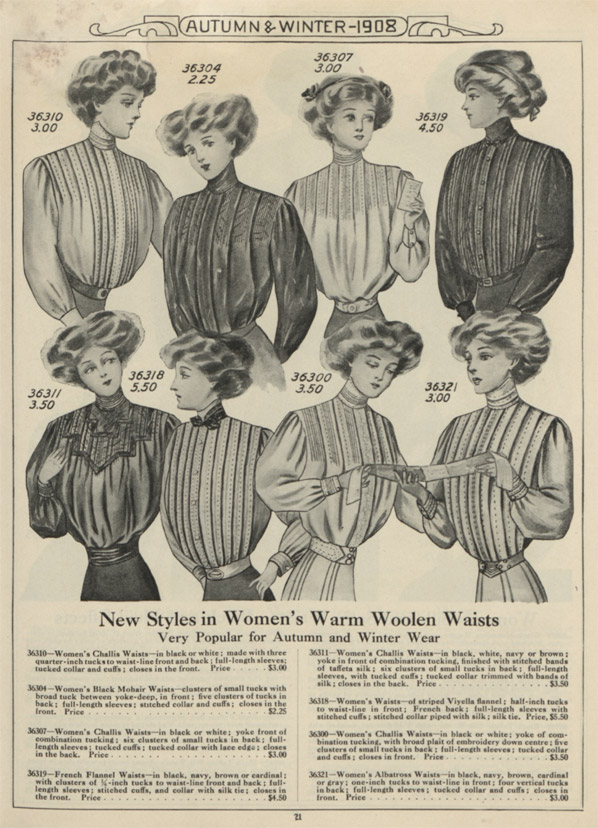
What Is a Shirt Waist?

Shirt waist designs from 1906, when Betsy would've been 14.
Click to enlarge. {Source}
I received a request to do some posts about fashions of time. (Thanks, Kate!) So today I will be talking about shirt waists.   

As the Betsy-Tacy books take place from 1897-1917, the fashions are set in three different periods: the late Victorian period (1837-1901), the Edwardian period (1901-1910; some sources say until 1914), and, finally, at the cusp of the era ushered in by World War I (1914-1918). As you can see, the Edwardian era was the main period which the clothing would be from, as those styles would have been popular through Betsy's adolescence. 

Edwardian shirt waists, probably from
the later part of the period. {Source}
These were twenty years of tremendous change--on the fashion front and in all other areas. One style, however, that remained popular throughout these two decades was the shirt waist (apparently it can be spelled as one word--shirtwaist--or two words--shirt waist--or simply called "a waist").
A simple shirt waist {Source}
Waist is a common term for the bodice of a dress or for a blouse or woman's shirt from the early 19th century through the Edwardian period.
A shirtwaist was originally a separate blouse constructed like a shirt. {Source}
The shirtwaist, a costume with a bodice or waist tailored like a man's shirt with a high collar, was adopted for informal daywear and became the uniform of working women. {Source}
Although skirt and blouse effects had been in and out of fashion for centuries, the shirtwaist with this button up the front bodice and attached skirt really took off in the Gibson Girl days of the early twentieth century. The no-nonsense skirtwaist could be softened with lace and trimmings or pared down for a crisp look. It fit perfectly the trend toward an acceptance of a more active, self-determinate woman.{Source}
So a shirt waist is basically just a blouse, usually worn over a corset and othe undergarments, and then tucked into a skirt. There are many mentions of shirt waists in the Betsy-Tacy series: 
Betsy made sure that her hair was in curl. She put on a crisp hair ribbon and a white ruffled shirt waist, fresh from Anna's iron. (Heaven to Betsy, 297)
…Betsy returned to school wearing a clean, starched shirt waist and even more stiffly starched resolves." (Betsy and Joe, 489)
1908 shirt waist styles (Betsy would be 16). {Source}
In some of these photos, you will notice the unusual posture of the women. This was what was referred to as the "S Curve."
{Source}
The Edwardian woman strove for a deep bosom, a tiny waist, and rounded hips - not so different from the ideal of other periods. What made the Edwardian fashion figure unusual (though not unique) was the S-curved corset that pushed the bosom forward and the hips backward into a S-shaped silhouette when view from the side. {Source}
I am not sure if this is a style that Betsy adopted. I don't recall seeing any photos of her or her friends in this exaggerated pose, but that doesn't mean that they didn't try to emulate it! In any case, it doesn't look very comfortable to me. I also don't know how Betsy could fall into her Ethel Barrymore droop with a corset like that...

I know that there are probably shirt waists pictured in Vera Neville's illustrations, but I don't have the books with me to check right now. I also recall a photo (click link to view) featured in the back of one of the high school books (I think it was Betsy Was a Junior) where the real life girls that inspired the female characters of Okto Delta are all standing together. I am quite sure that they are all wearing shirt waists in this picture {image source}. Now that you know what this style is, I'm sure that you will notice them a lot in the books. Maud gave many great descriptions of the clothes worn throughout the series, and this is a topic that I look forward to exploring more in the future.

I hope that I have all this information correct. I am not a history or fashion expert! If you would like to read more (or check my facts!) here are some of the sources I consulted when compiling this post: