Showing posts with label people. Show all posts

Friday, December 2, 2011

Review of *Future in a Handbasket: The Life and Letters Behind Carney's House Party*

    "Myself, I like the world ordinary people live in. I just want the Loco, lots of fishing, poker at low stakes, my sax . . . a home and kids sometime, of course. A girl like you, I think, would like a home and kids, with music just for the frosting on the cake.
    "You'll keep playing the piano. Probably your husband will hound you to play for him every night after supper. But as the kids grow older you'll play less and less. And you won't feel bad about that, for one of the kids will be musical, maybe . . . All your technical skill and talent plus a little from his dad. Say, that would be swell!"
    "Wouldn't it!" They glowed at each other.
    There was a shout from downstairs. "Carney! Sam! Where are you?"
    Carney jumped up and she saw the third floor room had grown quite dim. Beyond the tall windows the western sky was a sheet of flaming color.
    "Heavens!" she cried. "It's time to go home."
    Sam put his hand over hers. He gave it a warm squeeze.
    "There's your future in a handbasket," he said. (Carney's House Party, 128)
After reading Future in a Handbasket, that exchange from Carney's House Party has a whole new meaning.  I recently read and enjoyed Amy Dolnick's book about the real Carney, Marion Willard Everett, and decided to share some of my thoughts on it. If anyone follows me on Goodreads, this is just a slightly altered version of the review I posted there.

Some of Marion’s college letters are a bit gossipy, and not as interesting to me as the rest of the book (but still enjoyable). It seems like it would’ve been really fun to go to Vassar in those days. In that section in particular, I found it hard to keep track of who’s who (some people mentioned had the same name, and then there are the fictional names based on some characters...so it gets confusing). The footnotes were very helpful. If anything, I wished for more of them (and it might be nice if they were at the bottom of each page and not at the end of the chapters). It also struck me while reading this how people really knew how to write good letters then. I'm afraid that is something that is becoming extinct. But maybe we just write good e-mails instead?

I greatly enjoyed reading the parts about how Marion and Bill raised their children, and their life as a family. I also found the war letters to be extremely interesting. **SPOILER: Ted’s death really caught me off guard; I was not expecting that at all.  His letters were very touching and introspective. **END OF SPOILER** Tears were shed more than once during the reading of this book. I’m still confused about who is Willy/Bill and who is Ted/Ed in the photos. It seems like they are labeled inconsistently. Why didn’t we get to read any of Will’s wartime letters?

The letters from Maud Hart Lovelace to Marnie are absolutely delightful, and it makes me admire Lovelace even more. An example of an interesting quote from one of Maud's letters:
“I like to work a little religion into these books. You'll notice that I usually manage to.” (161)
I never realized that Maud liked to work these themes into her books, but looking back at the series I can definitely pick up on that. I also learned that Maud called Delos "Delossy" (159)! Cutest Maud trivia I've learned in awhile. Delos helped Maud with a lot of her male characterizations, which is another thing I learned reading this. It was interesting to get a small peek at Maud as a wife and mother. It sounds like her daughter Merian was very smart and busy with many school activities.

My biggest pet peeve with this book is that we aren’t given the responses to letters. I feel like we only get one side. The part where this bugged me to the point of frustration was in Maud’s correspondence with Marion while preparing to write, and during the writing of Carney's House Party. Maud would ask questions, but Marion’s answers were not all published! I really wanted to get to know Marion through her own words as she grew older. Were those letters just not available? Did anyone else who's read this feel this frustration? Maybe there is a good reason they were left out, I don't know. I also wanted to hear more about Kathleen Baxter and friends' visit with Marnie in the '60s.

Dolnick did a marvelous job; I’d love to read her other Maud-related books. The real people in this book seem like such lovely individuals. I kind of feel like each of the Crowd members deserves a book like this! It would've been amazing to meet them all. I think it is neat how so many of them stayed friends throughout their entire lives.

I consider this a must-read for fans of the Betsy-Tacy series and Deep Valley books, especially those that love Carney's House Party.

Have you read this book? If so, what did you think of it? I really appreciate all of the work that went into it. There are also a lot of great photos included.

I think this book is out of print, but you can find it used online--or interloan it from your local library system, which is what I did.

Tuesday, November 8, 2011

Lillian Russell and Mrs. Poppy

As I mentioned in the Chauncey Olcott post, Lillian Russell comes up a couple times in the Betsy-Tacy series.

In Betsy and Tacy Go Downtown, Mrs. Poppy is described  as looking "like the famous beauty and actress, Lillian Russell…except that she was stouter, of course." (485)

What do you think? Does Mrs. Poppy (a.k.a. Roma Saulpaugh) resemble Miss Russell? 


Russell is mentioned again in Betsy and the Great World when Betsy gets the doll--"The yellow-haired charmer with the pink plume on her hat."--while visiting Sonneberg, Germany:
She marched out triumphantly with the pink and blue beauty. "She looks just like Lillian Russell," Betsy thought. (235) 
So, just who was this woman?
Lillian Russell (December 4, 1861 – June 6, 1922) was an American actress and singer. She became one of the most famous actresses and singers of the late 19th century and early 20th century, known for her beauty and style, as well as for her voice and stage presence. […] For many years, she was the foremost singer of operettas in America, performing continuously through the end of the nineteenth century. In 1899, she joined the Weber and Fields's Music Hall, where she starred for five years. After 1904, she began to have vocal difficulties and switched to dramatic roles. She later returned to musical roles in vaudeville, however, finally retiring from performing around 1919. In later years, Russell wrote a newspaper column, advocated women's suffrage and was a popular lecturer. {Source}
 In 1940 there was a movie made about her, with Alice Faye in the title role.

You can hear Lillian Russell sing here (this song was recorded in 1912, which would've been slightly before Betsy and the Great World takes place. It's also after she apparently started to have vocal difficulties. Hmm). This isn't the greatest recording, but it gives you an idea of what she sounded like. While Russell is very lovely, the American concept of ideal female beauty has certainly changed over the years (I'm not necessarily saying that's a good thing...but that's a discussion for another day!).

Wednesday, November 2, 2011

Chauncey Olcott

Yes, Chauncey Olcott was a real person! I always love the parts in the high school Betsy books where each September, as a kind of autumn ritual, her family goes to hear the Irish tenor perform in the Deep Valley Opera House.
{Source}
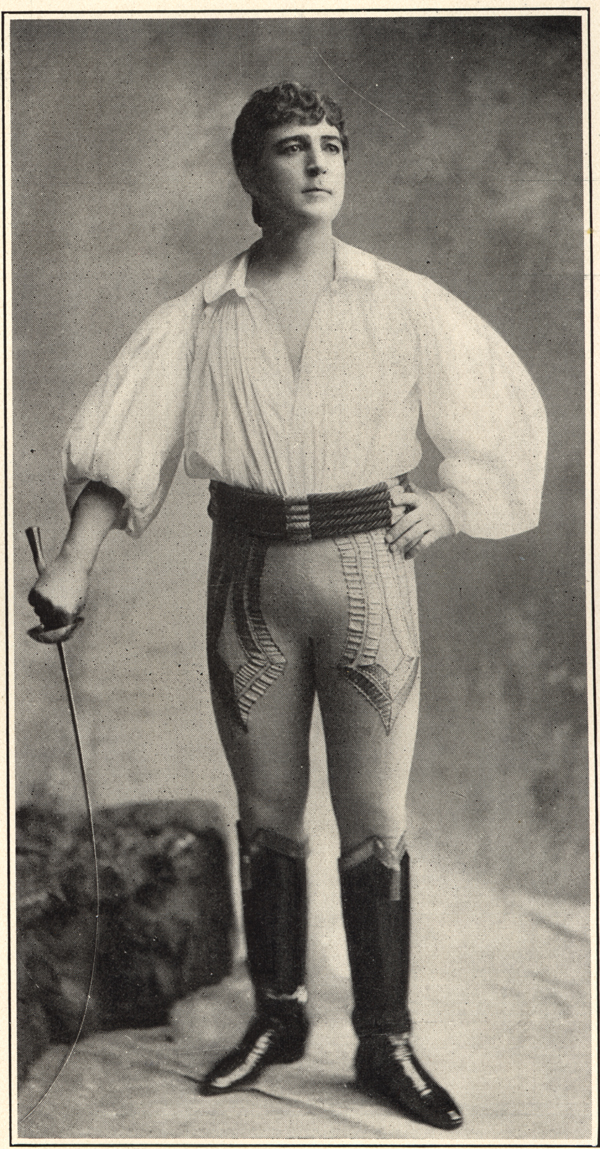
    Chauncey Olcott came to Deep Valley in his play, Aileen Asthore. Mr. Ray took the family to hear him. Usually Betsy saw her rare plays at matinees with Winona who had passes because her father was editor of the Deep Valley Sun. but once a year when Chauncey Olcott came, she went to the Opera House in the evening with her parents.
    The Irish tenor was growing old and stout, but his swagger was as gallant as ever, his voice as honey sweet. Always in the course of the evening the audience made him sing a hit song of earlier years called, "My Wild Irish Rose." At the end of the second act when he came out to take his curtain calls, someone in the audience would shout, "My Wild Irish Rose," and others would take up the cry. Chauncey Olcott would laugh, shake his head, make gestures of protest, but the cries would continue, and at last the curtain would got up again, and he would hoist himself a trifle heavily to a table or bench, and the orchestra would being the much-loved song.
    Mr. Ray would take Mrs. Ray's hand then. Julia, Betsy and Margaret…whose eyes were blazing like stars in the excitement of going to the Opera House… would settle back to enjoy each honied note.
    "Of course," Julia said to Betsy afterwards, "that isn't great music."
    "Why, the idea!" cried Betsy. "If that isn't great music, I'd like to know what is."
    "Grand Opera," answered Julia.
    "Like that Pagliacci you sing?"
    "Of course. But Chauncey Olcott is a sweet old thing."
    "A sweet old thing!" Betsy was indignant. She and Tacy agreed that Chauncey Olcott was the finest singer in the world.  (Heaven to Betsy, 125-126)
{Source}
As happened every September Chauncey Olcott came to the Opera House and Mr. Ray took the family to hear him. … This year's play,  was called O'Neill of Derry. But the name didn't matter much. The play was always like last year's play, and probably next year's too. They were all laid in Ireland, they were full of plumed hats, high boots, laced bodices; and the Irish tenor, still handsome although stoutish, always sang the ballad he had earlier made famous:

"My wild Irish rose,
The sweetest flower that grows…"

    When he began Mr. Ray always took Mrs. Ray's hand, and the girls sat very still, not to miss a note or quaver. Even Julia enjoyed it, although she infuriated Betsy later with condescending remarks.
    "Chauncey Olcott," she said, "should really have done something with his voice."
    "Done something!" Betsy repeated. "Done something! He's made himself famous with it. What do you call doing something?"
    "He might have sung real music. Oh, Bettina, you must hear Mrs. Poppy's records! You must hear the really great ones…Caruso, Scotti, Melba, Geraldine Farrar…"
    "Chauncey Olcott," said Betsy stubbornly, "is good enough for me." (Betsy in Spite of Herself, 399-400)
I love Betsy's staunch loyalty here. :)

So, who was Chauncey Olcott? Here is a bit of information on him from Wikipedia:
{Source}
Chancellor "Chauncey" Olcott (July 21, 1858 – March 18, 1932) was an American stage actor, songwriter and singer.

Born in Buffalo, New York, in the early years of his career Olcott sang in minstrel shows and Lillian Russell played a major role in helping make him a Broadway star. Amongst his songwriting accomplishments, Olcott wrote and composed the song "My Wild Irish Rose" for his production of A Romance of Athlone in 1899. Olcott also wrote the lyrics to "When Irish Eyes Are Smiling" for his production of The Isle O' Dreams in 1912.

He retired to Monte Carlo and died there in 1932. His body was brought home and interred in the Woodlawn Cemetery in The Bronx.

His life story was told in the 1947 Warner Bros. motion picture My Wild Irish Rose starring Dennis Morgan as Olcott.

In 1970, Olcott was posthumously inducted into the Songwriters Hall of Fame.
I thought it was interesting that Lillian Russell was mentioned here, as she also pops up more than once in the Betsy-Tacy series. (Stay tuned for a post on that.)

Here is a recording of Chauncey singing his famous "My Wild Irish Rose." This particular copy sounds a little creaky, though, and I would recommend visiting this link at the Songwriters Hall of Fame for a clearer excerpt of the song. 


What do you think? I kind of like his voice, and I can see why it would be such a memorable experience for the Ray family to hear him in person.

I was unable to hunt down a copy of the 1947 film about Olcott's life, but I did find this part of a scene from the movie. Dennis Morgan plays the main character. Perhaps this was like the shows that Betsy and her family saw each year? 


Additional Links: