Showing posts with label Betsy and Joe. Show all posts

Thursday, November 24, 2011

A Deep Valley Thanksgiving

I hope you are all having a happy Thanksgiving! In this post I am going to share some of the wonderful passages from the books about this holiday.

This picture is from Chapter 14 of Heaven to Betsy and isn't related to Thanksgiving.
But we can just pretend that Cab, Herbert, and Tony (the one waving the knife)
are cooking us Thanksgiving dinner... instead of a surprise Sunday night lunch,
which is what they're actually doing (164-165)

I didn't include the mention of Thanksgiving that occurs in Betsy and Tacy Go Downtown (584-585), because it is brief, and seems more like a winter story (to refresh your memory: "the night after Thanksgiving night" is when they went bobsledding. I'm surprised they had that much snow in November!) But here are some Thanksgiving mentions from many of the other books:
The Slades came for Thanksgiving dinner, bringing Tom who was home on vacation, which made the occasion eventful for Betsy. He was not only that highly desirable creature, a boy, but he was an old friend. He and Betsy and Tacy hard started school together. (Heaven to Betsy, 181)
The days slipped along to Thanksgiving. Tom came home, and that meant parties. Carney, Irma, and Winona all gave parties, and  Tony took Betsy to Winona's, while both he and Cab accompanied her to Irma's. (Betsy in Spite of Herself, 454)
The Rays had Thanksgiving dinner with the Slades this year. The families entertained each other at Thanksgiving, turn and turn about. The dinner was magnificent, as usual, and after it was finished, the grown people napped, Margaret went roller skating, Harry took Julia to the Majestic, and Tom and Betsy went for a walk. (Betsy in Spite of Herself, 455-456)
If Margaret was able to go roller skating, there must not have been snow that year! 
Julia came home for Thanksgiving. The train swept down the track with a special brilliance because it carried Julia. She alighted looking citified, and soon filled the Ray house with color and excitement. […]
    The Rays and Slades always had Thanksgiving dinner together. It was at the Ray house this year and was followed about twilight by Mr. Ray's turkey sandwiches and coffee, and Grandma Slade's stories. (Betsy Was  a Junior, 151-152)
[…] Thanksgiving was upon them. This year it was the Slades' turn to entertain. The Rays alternated Thanksgiving dinner with their friends, the Slades. (Betsy and Joe, 440)
"Let's go up to the Kellys'," [Tom] said off-handedly, after Thanksgiving dinner was over.
    The Kelly house was crowded with brothers and sisters home for the holidays. Tom and Betsy were warmly welcomed and offered nuts, chocolates, apples, and spare pieces of pie. (Betsy and Joe, 441)
 And I can't leave out Emily:
Thanksgiving was near now. Emily and Aunt Sophie were drawn together by their mutual eagerness.
    "You and your grandfather are coming for Thanksgiving dinner," Aunt Sophie reminded. (Emily of Deep Valley, 137)
The Betsy-Tacy books--another thing to be thankful for! : ) HAPPY THANKSGIVING!

Monday, November 21, 2011

Pompadours, Part 1: Women's Styles

One of the things I wondered about most when I first read the Betsy-Tacy series was what is this thing called a pompadour? It seemed to be a hairstyle of some sort, and Maud mentions them quite frequently--on both men and women. So how could they both have the same hairstyle? It's all very puzzling. Well, apparently I'm not the only one who has wondered about the mysterious pompadour. I've received a couple questions in the giveaway post (you have until tomorrow to enter!) from others who are wondering about this. In one such comment a B-T fan named Marissa wrote:
Pompadours. 1). Why are they mentioned so frequently in the Betsy/Tacy series? 2). Why is that word so hard to say? 3). What were they exactly? How can both men and women have pompadours? Why is Joe Willard's pompadour so fabulous? What makes a pompadour more special than regular hair? It is mentioned so much in the books, I am quite perplexed. I'd love a little ditty all about pompadours with perhaps a picture or two.
It's sounds like we've been wondering many of the same things! Never fear; in this post I plan on addressing all of those questions and more (although I don't think I can give a reason why "Joe Willard's pompadour is so fabulous." I think it just is.)

There is a difference between the men's and women's pompadours. This post will talk about the women's version. 

First things first: how do you say "pompadour." According to Merriam-Webster, it is pronounced:
pom·pa·dour (päm-pə-ˌdȯr)
If you'd rather hear what it sounds like, there  is a handy site you can go to just for this purpose. All you have to do is type in the word and click on "Say it!". 

So what exactly is a pompadour? 
Pompadour 
Any hairstyle with the hair brushed back and arranged up creating a puffy effect. Variations were especially popular in the 18th century and in the late nineteenth and early 20th centuries.{Source}
The pompadour could take many forms, from a simple topknot (left) to series of
more elaborate poufs and curls (right). {Source}
The pompadour hairstyle or the 'Gibson girl' look was seen pretty much throughout the Edwardian period, 1901-1912 and was worn by women from the working classes to society ladies. The style is quit [sic] 'pouffy' right around, with the ends of the hair either tucked into a roll at the back or formed into a bun on top .... {Source}
In this illustration by Charles Dana Gibson, the women pictured
are all wearing a variation of the pompadour hairstyle. {Source}

As to why this style is mentioned so frequently in the series, I can only think that it is because it was an especially popular way of doing one's hair during the period in which these books take place. Also, I imagine that in the early 1900s putting one's hair up, as with wearing longer skirts, was a sort of a coming-of-age thing. Now that Betsy and her friends are in high school, they are growing up. Paying attention to the fashion mentioned in this series shows the outward signs of their blossoming maturity. But perhaps Maud just really liked the word!

Now that you know what this style is, I'm sure you will recognize it a lot in Vera Neville's lively illustrations. (Lois Lenski also draws a few pompadours on Mrs. Ray, Mrs. Muller, Mrs. Kelly, etc.)

To achieve the illusion of added volume, women would use "rats" (made from matted hair cleaned out of the hairbrush or horsehair), frames, back-combing, or other forms of padding. Also:
None of the hairstyles of the day would have been accomplished without firm hair pins made of much heavier wire gauge than those used in hairpins today. {Source}
There are many mentions in the series of the methods used to construct these hairdos: 
Betsy shows off her transformation hairstyle to Tib in  
Betsy in Spite of Herself. Illustration by Vera Neville.
[Tib] looked at Betsy keenly. "I know a wonderful way to do your hair."
    "How?"
    "Come here and I'll show you."
    They went to the dressing table, and Tib asked for Betsy's biggest rat. She pinned it on firmly and erected a magnificent pompadour, topped off with a high, pointed knot. (Betsy in Spite of Herself, 536)
She fluffed Betsy's hair over the wire "jimmy" into an airy pompadour. (Betsy Was a Junior, 142)
I'm not sure what a jimmy is or how it's different than a rat. I was unable to find any information online about it.
Tib had come as usual to dress for the party with Betsy – and to do Betsy’s multiplicity of puffs. The pompadour was rolled over a big sausagelike mat and each puff was rolled over a small one.
    “The rat and all the little mice, Tony calls them,” said Betsy, acting lighthearted. (Betsy and Joe, 479)
I hope this cleared things up on the subjects of women's pompadours. Let me know if you have any questions and I'll see what I can find out.

Link:
Style your own Gibson Girl updo. This site  also links to some video tutorials (which I haven't watched).

>> Pompadours, Part 2: Men's Styles

Friday, November 4, 2011

What Is a Shirt Waist?

Shirt waist designs from 1906, when Betsy would've been 14.
Click to enlarge. {Source}
I received a request to do some posts about fashions of time. (Thanks, Kate!) So today I will be talking about shirt waists.   

As the Betsy-Tacy books take place from 1897-1917, the fashions are set in three different periods: the late Victorian period (1837-1901), the Edwardian period (1901-1910; some sources say until 1914), and, finally, at the cusp of the era ushered in by World War I (1914-1918). As you can see, the Edwardian era was the main period which the clothing would be from, as those styles would have been popular through Betsy's adolescence. 

Edwardian shirt waists, probably from
the later part of the period. {Source}
These were twenty years of tremendous change--on the fashion front and in all other areas. One style, however, that remained popular throughout these two decades was the shirt waist (apparently it can be spelled as one word--shirtwaist--or two words--shirt waist--or simply called "a waist").
A simple shirt waist {Source}
Waist is a common term for the bodice of a dress or for a blouse or woman's shirt from the early 19th century through the Edwardian period.
A shirtwaist was originally a separate blouse constructed like a shirt. {Source}
The shirtwaist, a costume with a bodice or waist tailored like a man's shirt with a high collar, was adopted for informal daywear and became the uniform of working women. {Source}
Although skirt and blouse effects had been in and out of fashion for centuries, the shirtwaist with this button up the front bodice and attached skirt really took off in the Gibson Girl days of the early twentieth century. The no-nonsense skirtwaist could be softened with lace and trimmings or pared down for a crisp look. It fit perfectly the trend toward an acceptance of a more active, self-determinate woman.{Source}
So a shirt waist is basically just a blouse, usually worn over a corset and othe undergarments, and then tucked into a skirt. There are many mentions of shirt waists in the Betsy-Tacy series: 
Betsy made sure that her hair was in curl. She put on a crisp hair ribbon and a white ruffled shirt waist, fresh from Anna's iron. (Heaven to Betsy, 297)
…Betsy returned to school wearing a clean, starched shirt waist and even more stiffly starched resolves." (Betsy and Joe, 489)
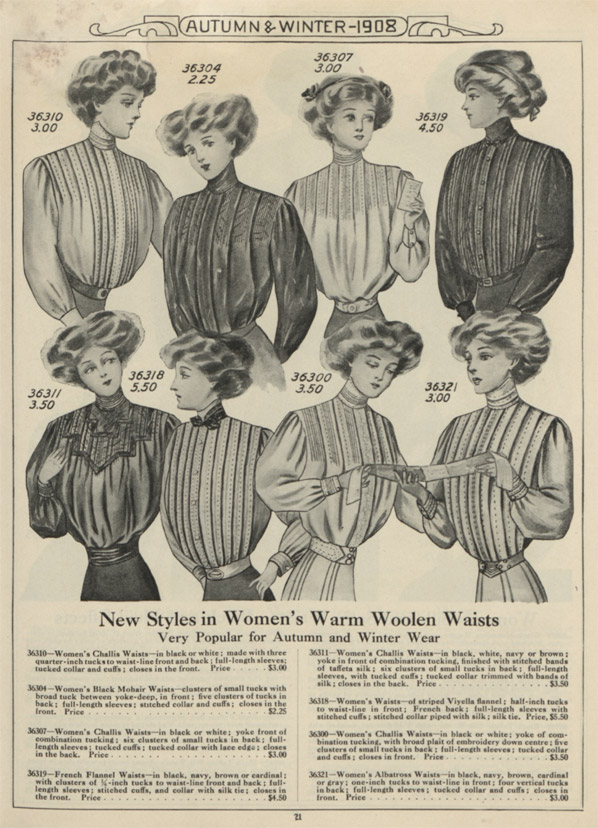
1908 shirt waist styles (Betsy would be 16). {Source}
In some of these photos, you will notice the unusual posture of the women. This was what was referred to as the "S Curve."
{Source}
The Edwardian woman strove for a deep bosom, a tiny waist, and rounded hips - not so different from the ideal of other periods. What made the Edwardian fashion figure unusual (though not unique) was the S-curved corset that pushed the bosom forward and the hips backward into a S-shaped silhouette when view from the side. {Source}
I am not sure if this is a style that Betsy adopted. I don't recall seeing any photos of her or her friends in this exaggerated pose, but that doesn't mean that they didn't try to emulate it! In any case, it doesn't look very comfortable to me. I also don't know how Betsy could fall into her Ethel Barrymore droop with a corset like that...

I know that there are probably shirt waists pictured in Vera Neville's illustrations, but I don't have the books with me to check right now. I also recall a photo (click link to view) featured in the back of one of the high school books (I think it was Betsy Was a Junior) where the real life girls that inspired the female characters of Okto Delta are all standing together. I am quite sure that they are all wearing shirt waists in this picture {image source}. Now that you know what this style is, I'm sure that you will notice them a lot in the books. Maud gave many great descriptions of the clothes worn throughout the series, and this is a topic that I look forward to exploring more in the future.

I hope that I have all this information correct. I am not a history or fashion expert! If you would like to read more (or check my facts!) here are some of the sources I consulted when compiling this post: