Showing posts with label Betsy in Spite of Herself. Show all posts

Thursday, November 24, 2011

A Deep Valley Thanksgiving

I hope you are all having a happy Thanksgiving! In this post I am going to share some of the wonderful passages from the books about this holiday.

This picture is from Chapter 14 of Heaven to Betsy and isn't related to Thanksgiving.
But we can just pretend that Cab, Herbert, and Tony (the one waving the knife)
are cooking us Thanksgiving dinner... instead of a surprise Sunday night lunch,
which is what they're actually doing (164-165)

I didn't include the mention of Thanksgiving that occurs in Betsy and Tacy Go Downtown (584-585), because it is brief, and seems more like a winter story (to refresh your memory: "the night after Thanksgiving night" is when they went bobsledding. I'm surprised they had that much snow in November!) But here are some Thanksgiving mentions from many of the other books:
The Slades came for Thanksgiving dinner, bringing Tom who was home on vacation, which made the occasion eventful for Betsy. He was not only that highly desirable creature, a boy, but he was an old friend. He and Betsy and Tacy hard started school together. (Heaven to Betsy, 181)
The days slipped along to Thanksgiving. Tom came home, and that meant parties. Carney, Irma, and Winona all gave parties, and  Tony took Betsy to Winona's, while both he and Cab accompanied her to Irma's. (Betsy in Spite of Herself, 454)
The Rays had Thanksgiving dinner with the Slades this year. The families entertained each other at Thanksgiving, turn and turn about. The dinner was magnificent, as usual, and after it was finished, the grown people napped, Margaret went roller skating, Harry took Julia to the Majestic, and Tom and Betsy went for a walk. (Betsy in Spite of Herself, 455-456)
If Margaret was able to go roller skating, there must not have been snow that year! 
Julia came home for Thanksgiving. The train swept down the track with a special brilliance because it carried Julia. She alighted looking citified, and soon filled the Ray house with color and excitement. […]
    The Rays and Slades always had Thanksgiving dinner together. It was at the Ray house this year and was followed about twilight by Mr. Ray's turkey sandwiches and coffee, and Grandma Slade's stories. (Betsy Was  a Junior, 151-152)
[…] Thanksgiving was upon them. This year it was the Slades' turn to entertain. The Rays alternated Thanksgiving dinner with their friends, the Slades. (Betsy and Joe, 440)
"Let's go up to the Kellys'," [Tom] said off-handedly, after Thanksgiving dinner was over.
    The Kelly house was crowded with brothers and sisters home for the holidays. Tom and Betsy were warmly welcomed and offered nuts, chocolates, apples, and spare pieces of pie. (Betsy and Joe, 441)
 And I can't leave out Emily:
Thanksgiving was near now. Emily and Aunt Sophie were drawn together by their mutual eagerness.
    "You and your grandfather are coming for Thanksgiving dinner," Aunt Sophie reminded. (Emily of Deep Valley, 137)
The Betsy-Tacy books--another thing to be thankful for! : ) HAPPY THANKSGIVING!

Monday, November 21, 2011

Pompadours, Part 1: Women's Styles

One of the things I wondered about most when I first read the Betsy-Tacy series was what is this thing called a pompadour? It seemed to be a hairstyle of some sort, and Maud mentions them quite frequently--on both men and women. So how could they both have the same hairstyle? It's all very puzzling. Well, apparently I'm not the only one who has wondered about the mysterious pompadour. I've received a couple questions in the giveaway post (you have until tomorrow to enter!) from others who are wondering about this. In one such comment a B-T fan named Marissa wrote:
Pompadours. 1). Why are they mentioned so frequently in the Betsy/Tacy series? 2). Why is that word so hard to say? 3). What were they exactly? How can both men and women have pompadours? Why is Joe Willard's pompadour so fabulous? What makes a pompadour more special than regular hair? It is mentioned so much in the books, I am quite perplexed. I'd love a little ditty all about pompadours with perhaps a picture or two.
It's sounds like we've been wondering many of the same things! Never fear; in this post I plan on addressing all of those questions and more (although I don't think I can give a reason why "Joe Willard's pompadour is so fabulous." I think it just is.)

There is a difference between the men's and women's pompadours. This post will talk about the women's version. 

First things first: how do you say "pompadour." According to Merriam-Webster, it is pronounced:
pom·pa·dour (päm-pə-ˌdȯr)
If you'd rather hear what it sounds like, there  is a handy site you can go to just for this purpose. All you have to do is type in the word and click on "Say it!". 

So what exactly is a pompadour? 
Pompadour 
Any hairstyle with the hair brushed back and arranged up creating a puffy effect. Variations were especially popular in the 18th century and in the late nineteenth and early 20th centuries.{Source}
The pompadour could take many forms, from a simple topknot (left) to series of
more elaborate poufs and curls (right). {Source}
The pompadour hairstyle or the 'Gibson girl' look was seen pretty much throughout the Edwardian period, 1901-1912 and was worn by women from the working classes to society ladies. The style is quit [sic] 'pouffy' right around, with the ends of the hair either tucked into a roll at the back or formed into a bun on top .... {Source}
In this illustration by Charles Dana Gibson, the women pictured
are all wearing a variation of the pompadour hairstyle. {Source}

As to why this style is mentioned so frequently in the series, I can only think that it is because it was an especially popular way of doing one's hair during the period in which these books take place. Also, I imagine that in the early 1900s putting one's hair up, as with wearing longer skirts, was a sort of a coming-of-age thing. Now that Betsy and her friends are in high school, they are growing up. Paying attention to the fashion mentioned in this series shows the outward signs of their blossoming maturity. But perhaps Maud just really liked the word!

Now that you know what this style is, I'm sure you will recognize it a lot in Vera Neville's lively illustrations. (Lois Lenski also draws a few pompadours on Mrs. Ray, Mrs. Muller, Mrs. Kelly, etc.)

To achieve the illusion of added volume, women would use "rats" (made from matted hair cleaned out of the hairbrush or horsehair), frames, back-combing, or other forms of padding. Also:
None of the hairstyles of the day would have been accomplished without firm hair pins made of much heavier wire gauge than those used in hairpins today. {Source}
There are many mentions in the series of the methods used to construct these hairdos: 
Betsy shows off her transformation hairstyle to Tib in  
Betsy in Spite of Herself. Illustration by Vera Neville.
[Tib] looked at Betsy keenly. "I know a wonderful way to do your hair."
    "How?"
    "Come here and I'll show you."
    They went to the dressing table, and Tib asked for Betsy's biggest rat. She pinned it on firmly and erected a magnificent pompadour, topped off with a high, pointed knot. (Betsy in Spite of Herself, 536)
She fluffed Betsy's hair over the wire "jimmy" into an airy pompadour. (Betsy Was a Junior, 142)
I'm not sure what a jimmy is or how it's different than a rat. I was unable to find any information online about it.
Tib had come as usual to dress for the party with Betsy – and to do Betsy’s multiplicity of puffs. The pompadour was rolled over a big sausagelike mat and each puff was rolled over a small one.
    “The rat and all the little mice, Tony calls them,” said Betsy, acting lighthearted. (Betsy and Joe, 479)
I hope this cleared things up on the subjects of women's pompadours. Let me know if you have any questions and I'll see what I can find out.

Link:
Style your own Gibson Girl updo. This site  also links to some video tutorials (which I haven't watched).

>> Pompadours, Part 2: Men's Styles

Wednesday, November 16, 2011

"Merry Widow" Fever

{Source}
One of the (many, many...) things I love about the Betsy-Tacy series is their incorporation of popular music. One piece, "The Merry Widow Waltz", is practically a character in Betsy in Spite of Herself.
The Merry Widow was the world’s first hit musical. The tremendous acclaim that accompa­nied its premiere in Vienna on December 30, 1905 brought instant fame to its thirty-five-year-old composer, Franz Lehár, and began an international success. In the century since, there has scarcely been a night without a performance somewhere in the world. {Source}
Author, blogger, and Betsy-Tacy fan Melissa Wiley did a post last year featuring this lovely waltz. Since she did such a great job, I won't try to say it all again. Just head over to her blog, Here in the Bonny Glen, to:
  • Hear what this waltz sounds like
  • Read the excerpt from Betsy in Spite of Herself when she first hears it while in Milwaukee
  • See a list of links relating to the song, including a funny gallery of postcards poking fun at the extravagant style of hats inspired by the piece
These photos are in the back of Betsy In Spite of Herself
Speaking of Merry Widow hats, these are also mentioned several times in Betsy In Spite of Herself. For example:
Beside him was a slight graceful girl, beautifully and expensively dressed in a gray suit with a big fluffy fur and a Merry Widow hat so wide that it made the one Betsy cherished in a box upstairs look positively narrow. (606)
"Tell Irma if she wants to see the Merry Widow, she can just come up and look at me."
    "You don't sound very heartbroken."
    "I'll put on my Merry Widow hat for her," Betsy joked. (645)
The first quote leads me to think that the bigger the hat, the more stylish you were! Do you remember in the post on shirt waists how I described the S-shape silhouette that was popular in the early 1900s? Well, as the new century wore on, a different shape came into vogue, hallmarked by the rise of the Merry Widow hat:
1907-8 saw the start of a new body silhouette called the Empire or Directoire where the long columnar outline that tapers to the feet is contrasted with the big Merry Widow picture hat.  The fashion designer Lucile had designed the original widow hat for an operetta in 1907, but it influenced hat fashions for 3 more years.  It was always black and encased in filmy chiffon or organdie and festooned in feathers. {Source}
Lily Elsie modeling the Merry Widow
hat designed by Lucile. {Source}
While Franz Lehar’s 1905 premier of The Merry Widow did give this beautiful and often outrageous hat its most well known name, the hat in general had already begun to grow larger and larger since the end of the 19th century. It now took on gargantuan proportions compared to its predecessors. As is often the case, fashion had its own logic; As [sic] the new century moved forward, a larger millinery style was required to accommodate the larger and very popular pompadour hairstyles. By the middle of the new decade waistlines were radically raised and skirts became much slimmer, without frills and decorations. A large-crowned and wide-brimmed hat created the needed sense of balance for the silhouette. Although one might wonder at the precise meaning of balance when the depth of the brim could be up to one foot! {Source}
Apparently, this opera took 1907-08 by storm. Besides hats and music, there is also mention in BISOH of Merry Widow Sundaes ("Merry Widow Sundaes were the rage" [583]). I was curious what this creation would be comprised of, so I looked it up. With the help of the very useful Google archives, I came across three different recipes for Merry Widow Sundaes. Clearly it wasn't a certain recipe that made this concoction unique, it was just cashing in on the popularity of Lehár's musical. I'm not sure what particular sundae was served at Heinz's, but here are the three period recipes I found:

MERRY WIDOW BANANA SUNDAE 
Place 2 No. 20 portions of chocolate ice cream close together on a split banana. Cover with whipped cream so as to make an oval mound, sprinkle with a little grated sweet chocolate and place 3 fresh cherries on top of the mound.
 MERRY WIDOW SUNDAE
 Place a cone of ice cream on a dish around the edge of which lay three vanilla wafers flat, the wafers marking the points of a triangle; now put a slice of banana at each point where the cakes join together, placing crushed peaches on one side of the dish and crushed strawberries on the other, sprinkle a little chopped nuts over the ice cream, and top off with whipped cream and a cherry. Price 15 cents-- The Soda Fountain.
From 1908 Druggists Circular:
MERRY WIDOW SUNDAE
Place a tall cone of strawberry ice cream in a flat dish, pour a little grape syrup and a little "champagne syrup" around the bottom; add two slices of peach, and on top of the cone balance a thin slice of pineapple topped off with an arabesque dab of whipped cream and a red cherry.
More Merry Widow links: 

Wednesday, November 2, 2011

Chauncey Olcott

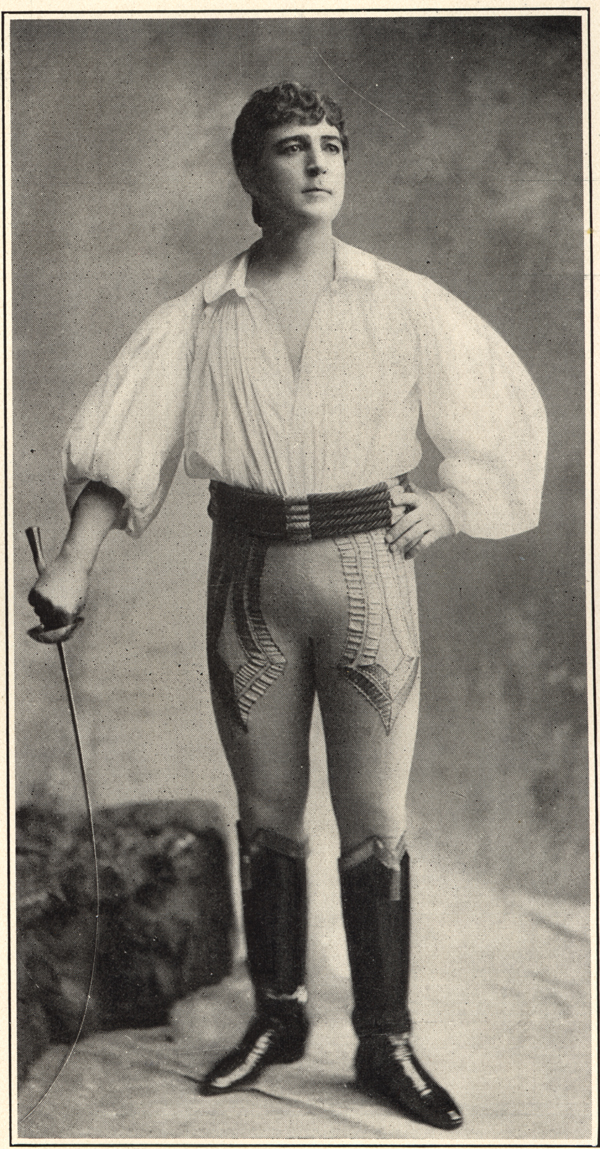
Yes, Chauncey Olcott was a real person! I always love the parts in the high school Betsy books where each September, as a kind of autumn ritual, her family goes to hear the Irish tenor perform in the Deep Valley Opera House.
{Source}
    Chauncey Olcott came to Deep Valley in his play, Aileen Asthore. Mr. Ray took the family to hear him. Usually Betsy saw her rare plays at matinees with Winona who had passes because her father was editor of the Deep Valley Sun. but once a year when Chauncey Olcott came, she went to the Opera House in the evening with her parents.
    The Irish tenor was growing old and stout, but his swagger was as gallant as ever, his voice as honey sweet. Always in the course of the evening the audience made him sing a hit song of earlier years called, "My Wild Irish Rose." At the end of the second act when he came out to take his curtain calls, someone in the audience would shout, "My Wild Irish Rose," and others would take up the cry. Chauncey Olcott would laugh, shake his head, make gestures of protest, but the cries would continue, and at last the curtain would got up again, and he would hoist himself a trifle heavily to a table or bench, and the orchestra would being the much-loved song.
    Mr. Ray would take Mrs. Ray's hand then. Julia, Betsy and Margaret…whose eyes were blazing like stars in the excitement of going to the Opera House… would settle back to enjoy each honied note.
    "Of course," Julia said to Betsy afterwards, "that isn't great music."
    "Why, the idea!" cried Betsy. "If that isn't great music, I'd like to know what is."
    "Grand Opera," answered Julia.
    "Like that Pagliacci you sing?"
    "Of course. But Chauncey Olcott is a sweet old thing."
    "A sweet old thing!" Betsy was indignant. She and Tacy agreed that Chauncey Olcott was the finest singer in the world.  (Heaven to Betsy, 125-126)
{Source}
As happened every September Chauncey Olcott came to the Opera House and Mr. Ray took the family to hear him. … This year's play,  was called O'Neill of Derry. But the name didn't matter much. The play was always like last year's play, and probably next year's too. They were all laid in Ireland, they were full of plumed hats, high boots, laced bodices; and the Irish tenor, still handsome although stoutish, always sang the ballad he had earlier made famous:

"My wild Irish rose,
The sweetest flower that grows…"

    When he began Mr. Ray always took Mrs. Ray's hand, and the girls sat very still, not to miss a note or quaver. Even Julia enjoyed it, although she infuriated Betsy later with condescending remarks.
    "Chauncey Olcott," she said, "should really have done something with his voice."
    "Done something!" Betsy repeated. "Done something! He's made himself famous with it. What do you call doing something?"
    "He might have sung real music. Oh, Bettina, you must hear Mrs. Poppy's records! You must hear the really great ones…Caruso, Scotti, Melba, Geraldine Farrar…"
    "Chauncey Olcott," said Betsy stubbornly, "is good enough for me." (Betsy in Spite of Herself, 399-400)
I love Betsy's staunch loyalty here. :)

So, who was Chauncey Olcott? Here is a bit of information on him from Wikipedia:
{Source}
Chancellor "Chauncey" Olcott (July 21, 1858 – March 18, 1932) was an American stage actor, songwriter and singer.

Born in Buffalo, New York, in the early years of his career Olcott sang in minstrel shows and Lillian Russell played a major role in helping make him a Broadway star. Amongst his songwriting accomplishments, Olcott wrote and composed the song "My Wild Irish Rose" for his production of A Romance of Athlone in 1899. Olcott also wrote the lyrics to "When Irish Eyes Are Smiling" for his production of The Isle O' Dreams in 1912.

He retired to Monte Carlo and died there in 1932. His body was brought home and interred in the Woodlawn Cemetery in The Bronx.

His life story was told in the 1947 Warner Bros. motion picture My Wild Irish Rose starring Dennis Morgan as Olcott.

In 1970, Olcott was posthumously inducted into the Songwriters Hall of Fame.
I thought it was interesting that Lillian Russell was mentioned here, as she also pops up more than once in the Betsy-Tacy series. (Stay tuned for a post on that.)

Here is a recording of Chauncey singing his famous "My Wild Irish Rose." This particular copy sounds a little creaky, though, and I would recommend visiting this link at the Songwriters Hall of Fame for a clearer excerpt of the song. 


What do you think? I kind of like his voice, and I can see why it would be such a memorable experience for the Ray family to hear him in person.

I was unable to hunt down a copy of the 1947 film about Olcott's life, but I did find this part of a scene from the movie. Dennis Morgan plays the main character. Perhaps this was like the shows that Betsy and her family saw each year? 


Additional Links: